
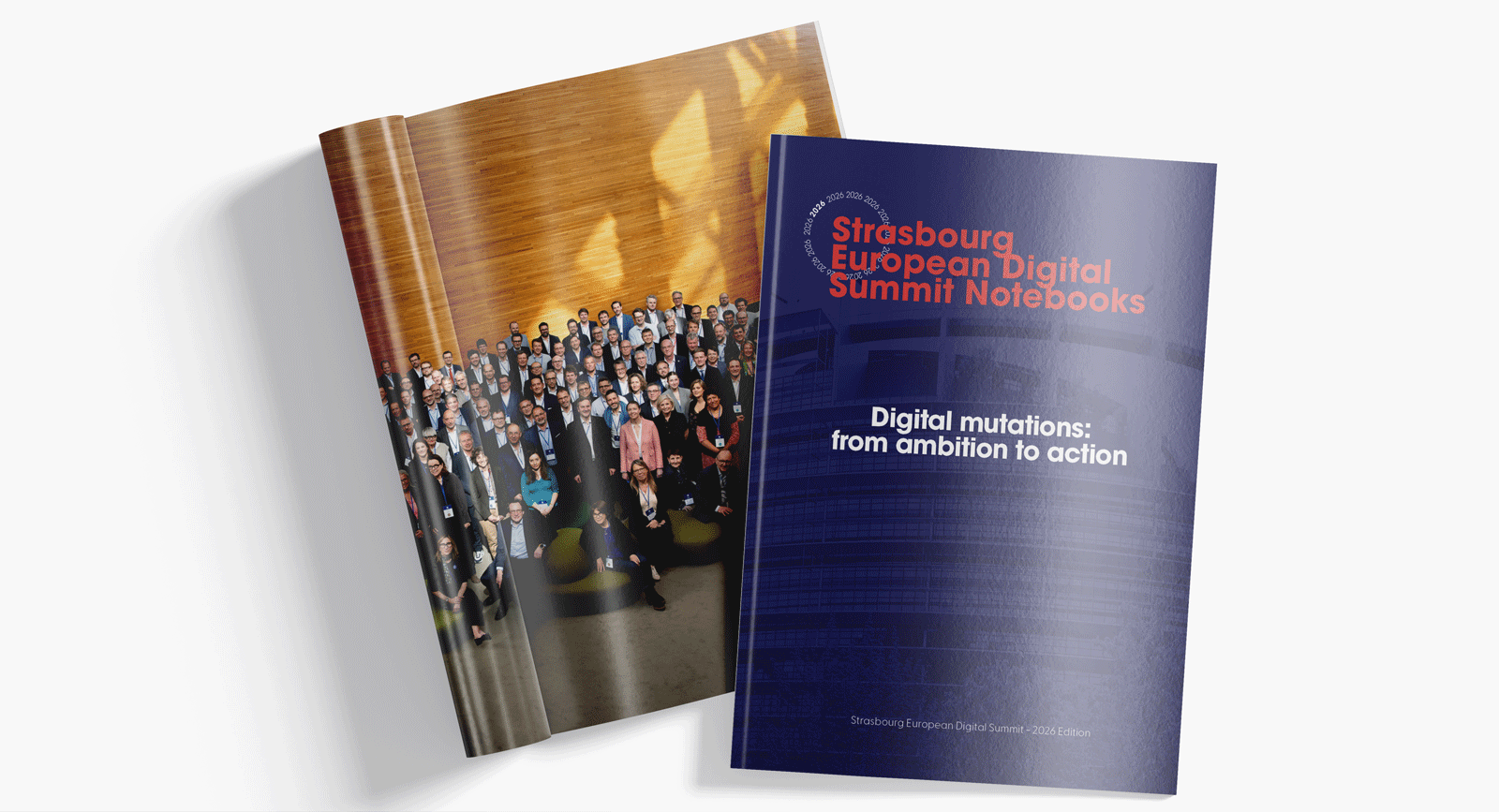
This third edition of the Notebooks reports on the strategic thinking of 200 digital decision-makers at the Strasbourg European Digital Summit, held from 15 to 17 April 2026. In particular, it sets out the commitments and recommendations made by the participants to the ecosystem and public authorities at the end of this major annual gathering of digital decision-makers.
Cette publication est disponible en français (French version)
From discussion to action: 2026 Summit confirms its role
The success of a demanding format at the heart of Europe
Nearly 200 leaders from the digital industry and major user organisations came together in Strasbourg to reflect on the various human, economic, technological and geopolitical challenges of digital technology, and to define a common path in the face of the changes underway. With a strong European dimension thanks to the participation of partner associations such as VOICE (Germany), CIO Platform Nederland (Netherlands) and Beltug (Belgium), this 2026 edition bears witness to the maturity of a format based on dialogue, collective intelligence and the construction of a shared vision at the service of competitiveness and resilience.
A roadmap submitted to the public authorities
At the end of the discussions, the concrete recommendations of the Strasbourg European Digital Summit community were officially presented to Anne Le Hénanff, Minister for Artificial Intelligence and the Digital Economy. This approach reflects the desire to inform the actions of public authorities in favour of a competitive, responsible and innovative digital sector. The conference also benefited from the support of the European Commission, represented by Matthew King, and the presence of Patrick Martin, President of MEDEF, and Frédérique Berrod, President of the University of Strasbourg, who came to underline the decisive importance of digital competitiveness for the entire economic fabric.
We would like to pay tribute to the commitment of the Grand Est Region and especially thank its vice-president, Nicolas Matt, for welcoming us and supporting the success of this event.
The content of the Notebooks: analysis and recommendations
Four plenary sessions to broaden your perspective
The 2026 Strasbourg European Digital Summit Notebooks presents the leading contributions that shaped the four inspirational plenary sessions, designed to provide decision-makers with an opportunity to take a step back from the transformations underway:
- The digital economy and how to deal with the inflationary impact of cloud and software services, analysed by Nicolas Bouzou (Asterès) and Adrien Peneranda (Sciences Po Toulouse).
- Public policy choices in the context of the global geopolitical and economic polycrisis, decrypted by Thomas Friang (ESSEC) and Maxence Brischoux (SGAE).
- The integration of artificial intelligence under the triple prism of economic performance, human capital and sobriety, debated by Yves Caseau (Michelin) and Yann Ferguson (INRIA / LaborIA).
- The European Union’s new approach to technological dependency and sovereignty, by Matthew King (European Commission Joint Research Centre).
Ten operational workshops to propose guidelines
At the heart of the Notebooks, the roadmaps resulting from ten collective intelligence workshops reflect the fruit of this reflection through shared convictions and recommendations for concrete action aimed at public and private players on these different themes.
- Digital sobriety and assessing the relevance of deployments via frugal AI.
- Digital inclusion and anticipating accessibility in the age of conversational and agentic interfaces.
- Strategic autonomy and digital resilience in the face of the risks of technological dependency.
- Deployment and industrialisation of the use of AI agents within operational models.
- New consumption models and the transition from ‘all cloud’ to Hybrid by Design architectures.
- Platformisation of business models and the challenges of open data spaces.
- The transformation of skills management and the orchestration of data flows at all levels of the enterprise.
- Supporting changes in the employment market by bringing the academic and professional worlds closer together.
- Public-private cooperation in the face of hybrid digital threats and the structuring of information sharing.
- Using European regulations (DMA, DSA, Cybersecurity Act) as a genuine tool for industrial strategy and competitiveness.